Copywriter Agent • Ocula
Every piece of generated copy started the same way: an email, a spreadsheet and someone on the internal team doing work the platform should have been doing.
What was going on
Ocula Technologies is an AI platform built for e-commerce brands and retailers. The core proposition: take product data and turn it into optimised, channel-ready content at scale. For large retailers managing thousands of product detail pages, that's a time-consuming, valuable problem to solve.
The engine, GC3.0, Ocula's generative copywriting model, was already built. It could produce brand-aligned product descriptions at a quality and volume no human team could match. The problem was how customers accessed it. Every job ran through Retool and each request had to come in by email. A member of the internal team received the brief, interpreted it, ran the generation, formatted the output and sent it back.
Two weeks after I joined, the Head of Design and I flew to London for a two-day sprint with the full leadership team: CEO, CTO, Product, Engineering and Data Science. The brief coming out of that sprint was clear: design a self-service platform that put the generation capability directly in the hands of customers.
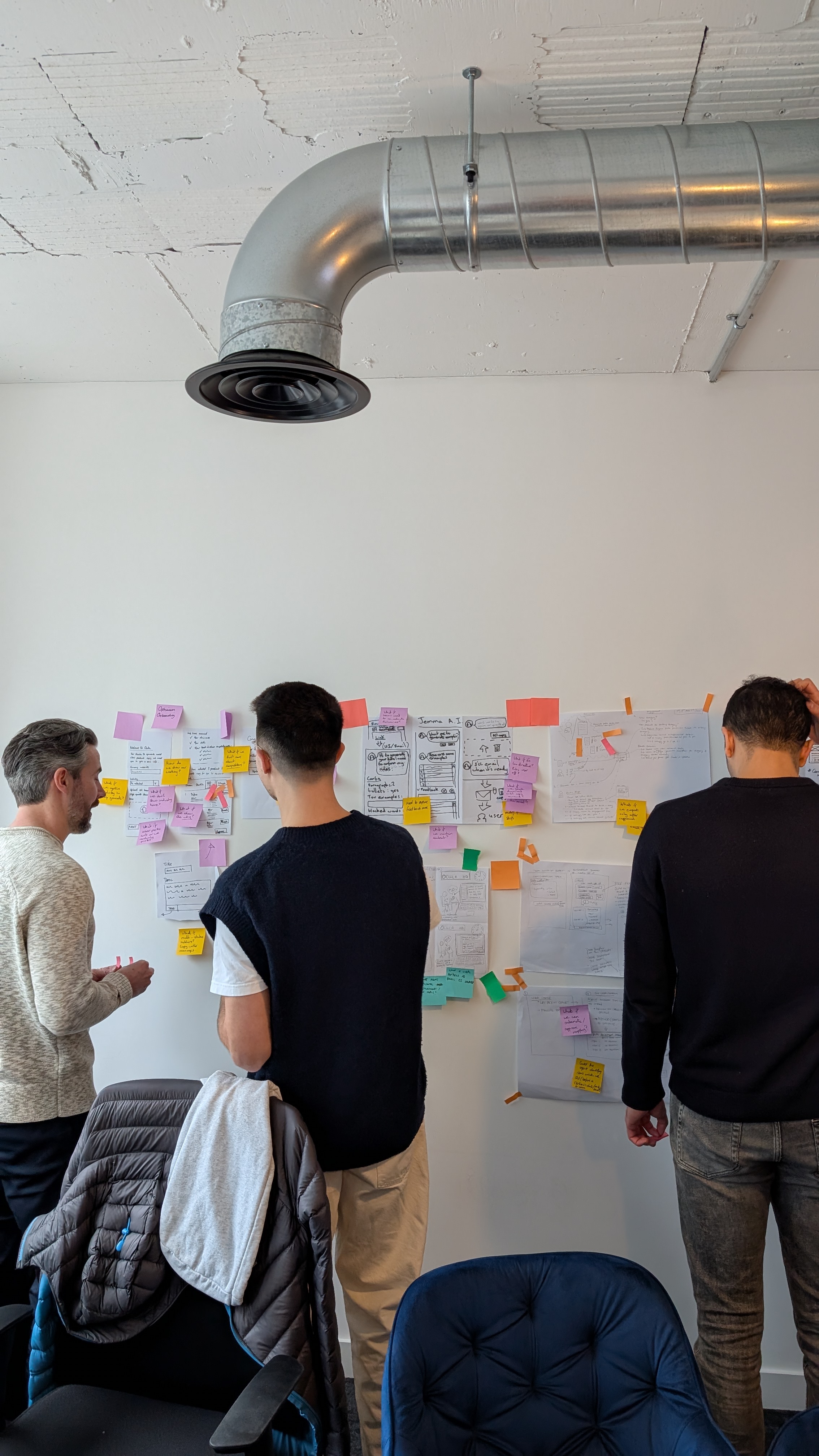
Two days in London with the team — where the project took shape
What needed solving
The absence of a customer-facing interface created two compounding problems. For customers, there was no autonomy. Generating copy required submitting a request, waiting for a response, reviewing an output they hadn't been directly involved in shaping, and going back-and-forth until it was right. For Ocula, every customer job was a support burden.
Moving to a product-market fit model meant breaking that dependency on Ocula staff. Customers needed to be able to request, receive and iterate on generated copy themselves.
What I was working with
When I joined, the company had recently pivoted and there was not much that aligned with the new design direction to inherit and no product layer to lean on in the early stages. There were few wireframes, minimal interface designs and no component library. The starting point was Retool, spreadsheets and email threads.
The team was small and the timeline was short: less than two months from sprint outcomes to shipped MVP. That meant making decisions quickly, with limited research runway, and trusting the sprint findings rather than running extended discovery of my own.
How I worked through it
Discovery & framing The sprint was my research. Two days in London with the CEO, CTO, Product, Engineering and Data Science gave me the customer context, the workflow detail and the commercial pressure behind the project. I left with clear outcomes and the job of executing them.
Exploring directions The configuration layer was the first thing I unpacked. Customers couldn't describe their content preferences in the abstract — they needed to see examples first. That insight directly shaped Sample and Feedback Loop: a flow built around reaction rather than a form. Proactive Insights emerged from a separate concern, that customers would engage once and disengage. I explored ways to make the platform pull customers back rather than wait for them to return. To move fast through early ideation, I used AI tools such as v0, to generate interface directions at a pace that matched the timeline.
Testing & refinement With a sub-two-month timeline there wasn't space for extended research rounds. I ran informal, async sessions with users and product champions, presenting work through recorded demos and gathering feedback iteratively.
Delivery & handoff This was the first deliverable built on the new component library, so documentation had to be airtight. I wrote clear component specs and usage guidelines for the Engineering handoff and established a Figma file structure that could scale now the design team was no longer a solo operation.
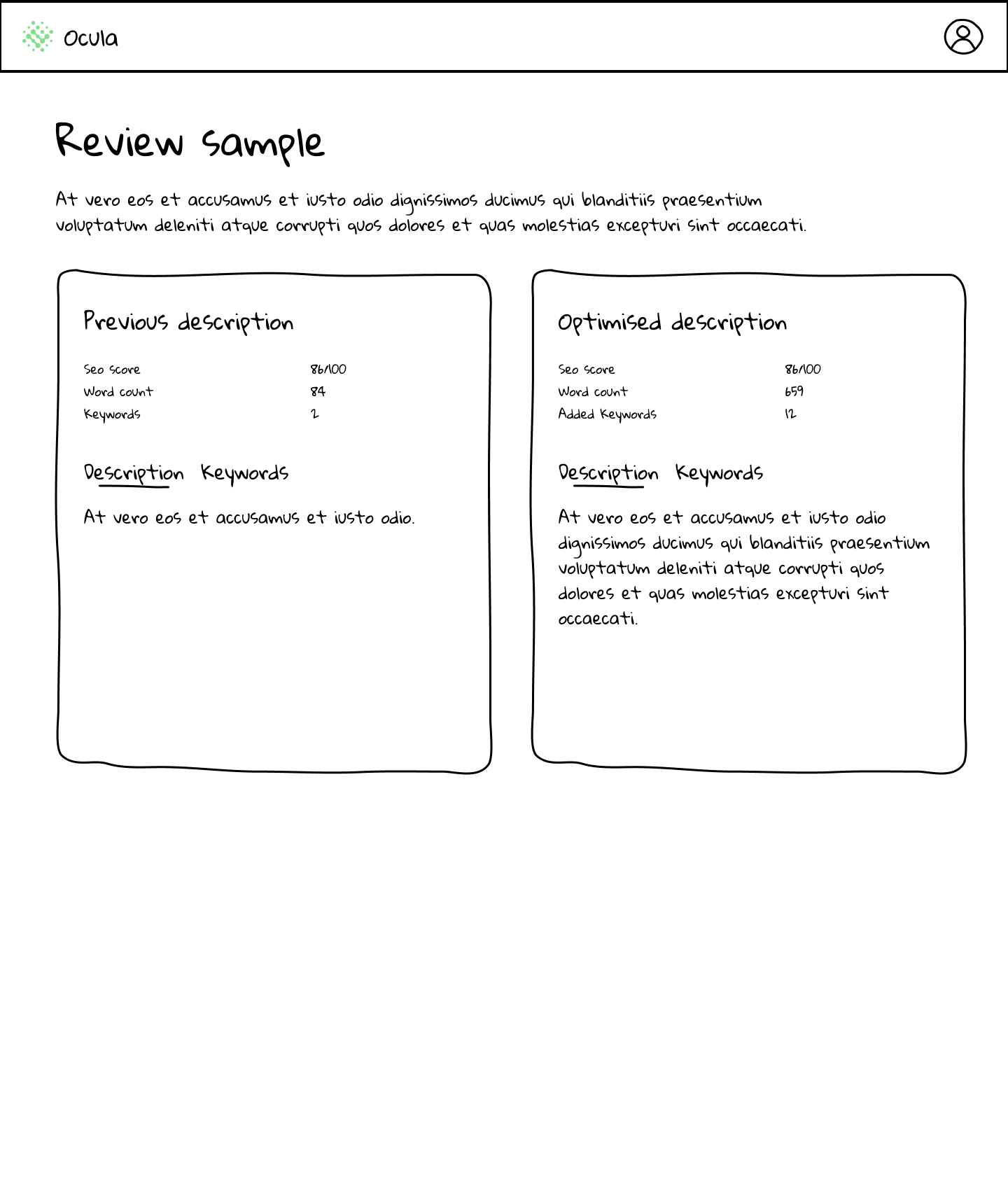
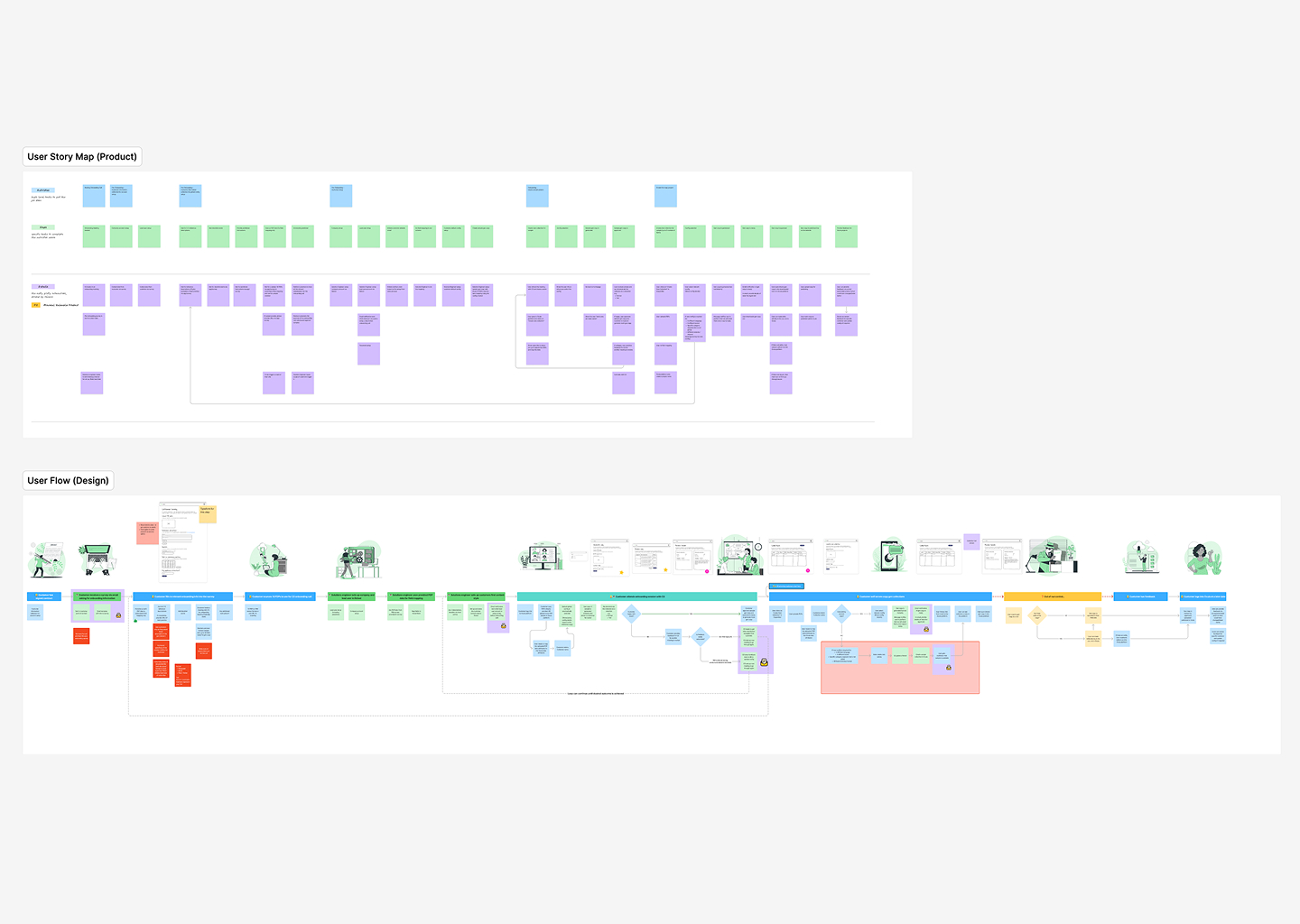
Early interface explorations and mapping exercises from the post-sprint ideation phase
What shipped and why
The Copywriter MVP gave customers a self-service interface to generate product copy at scale. The key design decisions across the three layers were:
The core generation flow was designed to feel lightweight and iterative, not transactional. Customers could scope a job, trigger generation and review results without needing to understand what was happening underneath. The interface made GC3.0's capability accessible without exposing its complexity to the user.
Sample and Feedback Loop replaced a previous, manual method using a Typeform survey. Customers began onboarding by reacting to real generated samples rather than filling in abstract preferences. Thumbs up, thumbs down, specific edits. The content style built from their responses and users could see it update in real time. The design goal was to move customers from uncertainty to confidence in their output before they committed to a full generation run.
Proactive Insights changed the relationship between the platform and the customer from reactive to ongoing. Rather than waiting for a customer to decide they needed to optimise copy, the feature identified the opportunity and surfaced it directly. Low-performing PDPs, outdated descriptions, content that hadn't been touched since launch: all flagged automatically with a clear prompt to act. The design kept the recommendations tightly scoped so they felt useful, not overwhelming.
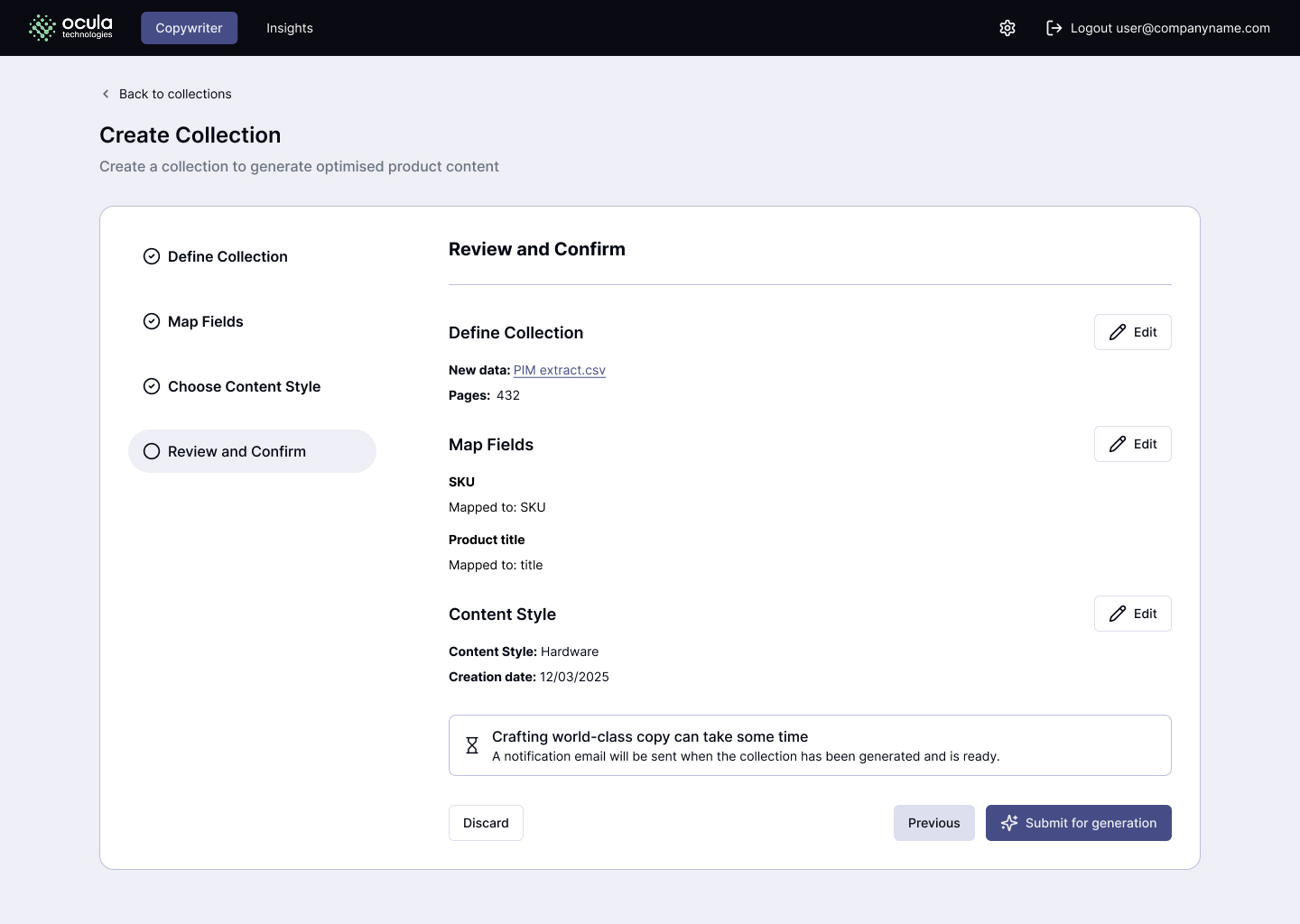
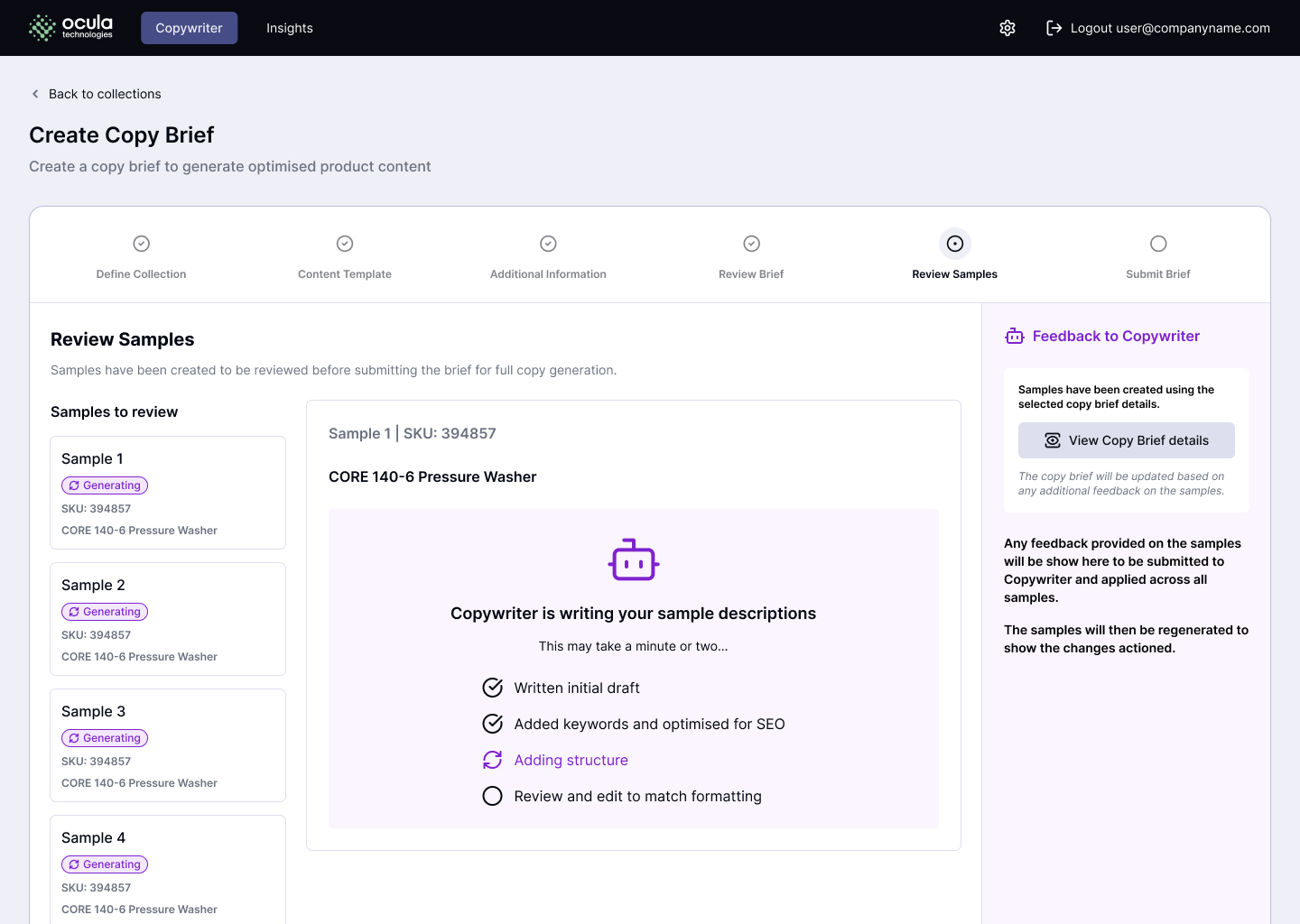
The shipped Copywriter MVP — customers could now request, generate and review copy without internal support
Content style built through reaction, not a form — customers rated samples and watched their preferences take shape in real time
What it changed
The most direct outcome was structural: Ocula's team stopped being the bottleneck for every customer job. The manual process that had been running through email and Retool was replaced by a platform customers could use themselves.
Sample and Feedback Loop reduced the back-and-forth that had been a persistent drain on Customer Success. Customers arrived at generation with a content style they'd had a hand in building rather than one the internal team had interpreted on their behalf and the number of revision cycles dropped significantly.
Finally, Proactive Insights gave the platform a reason to exist between campaigns. Engagement shifted from event-driven, triggered by a product launch, to ongoing. That was the commercial behaviour the business needed to move beyond a high-touch consultancy model.
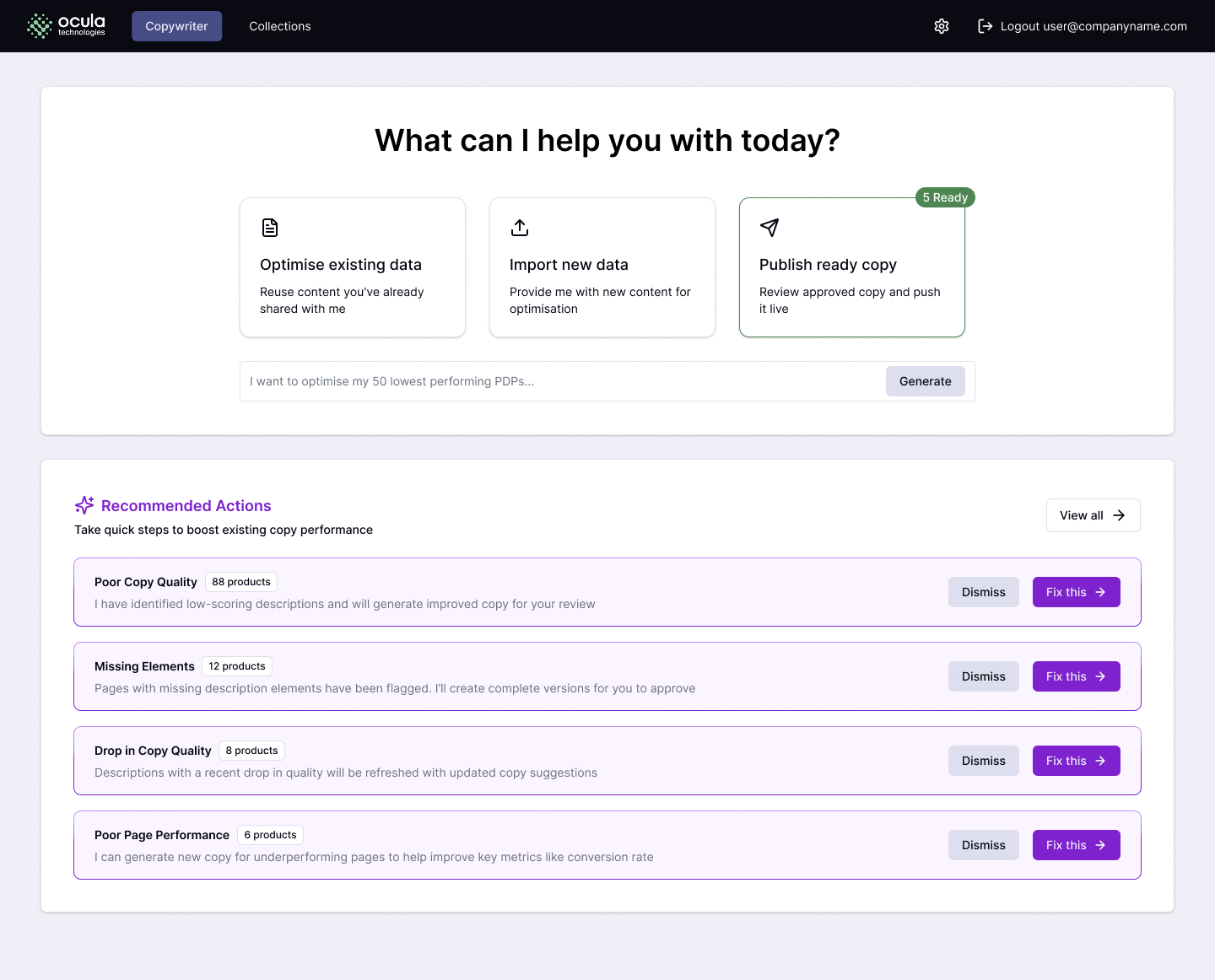
Low-performing and outdated PDPs surfaced automatically, giving customers a reason to keep coming back
What I'd do differently
The Sample and Feedback Loop was the right concept, but it moved quickly from sprint insight to shipped feature. What I'd have liked was a dedicated round of testing with customers specifically on the onboarding flow — not as part of the broader MVP validation, but as its own exercise. The configuration step is the moment customers form their first impression of the output quality. If they lose confidence there, they don't come back. I believe we got it right, but I'd have wanted more evidence before shipping rather than after.
Next case study
Power Search • Signifyd